
Works with every battery type
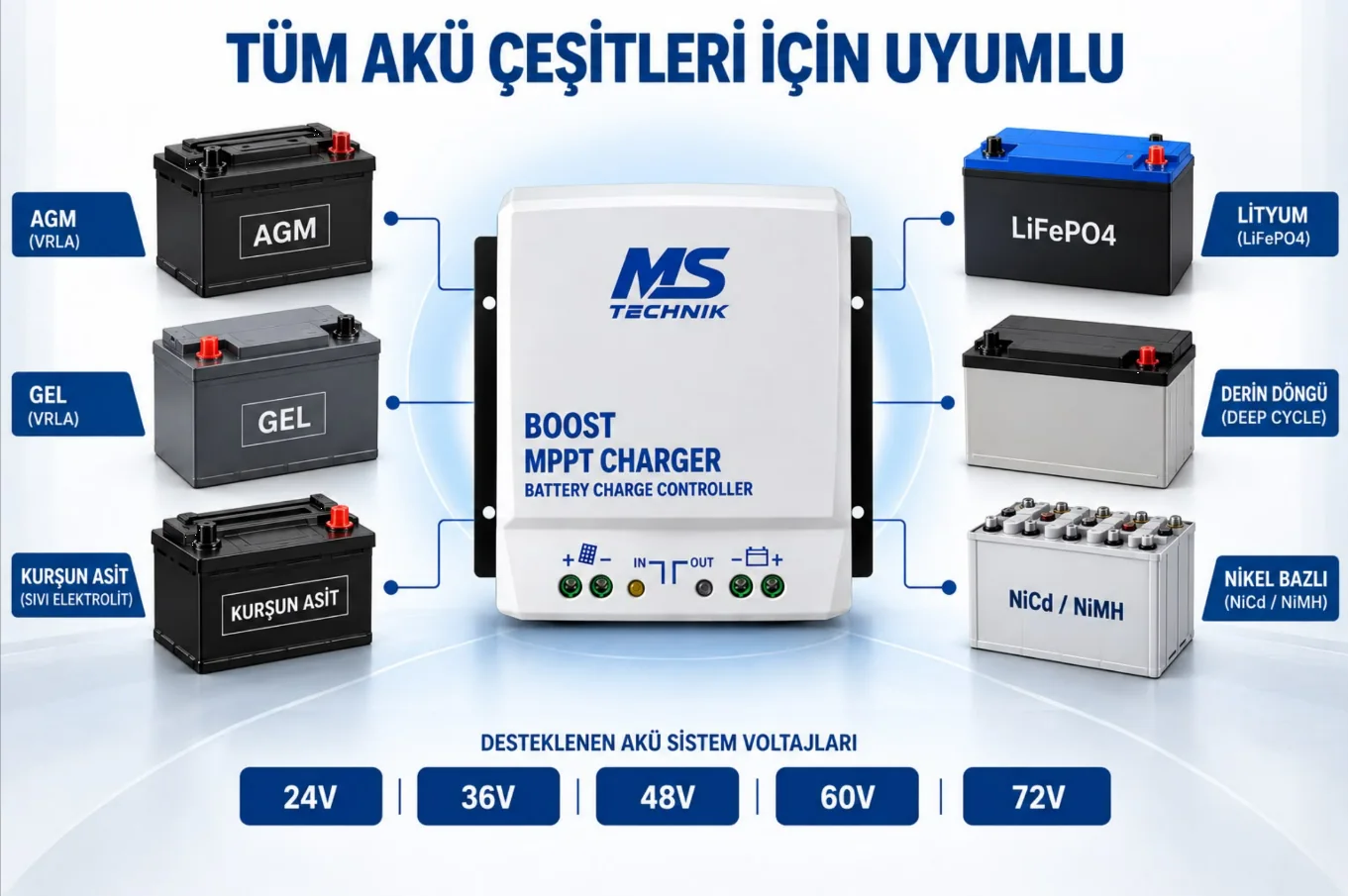
Works with AGM, gel, flooded lead-acid and lithium batteries. A user profile lets charge parameters match the battery maker's recommended values.


Charges your vehicle's battery bank straight from a solar panel — from 24 V to 72 V, with every battery type from AGM to lithium. You can buy the controller on its own; the panel and battery are not included, and we size the right panel for your vehicle together during the free site assessment.
₺7.250 ≈ $146
Price includes VAT and shipping.
💰 By bank transfer: ₺7.250
Works with AGM, gel, flooded lead-acid and lithium batteries. A user profile lets charge parameters match the battery maker's recommended values.
Charge parameters are set from your phone, and system status is monitored in the same place.
Works with 24, 36, 48, 60 and 72 V battery systems; configured to your vehicle's rating plate.
Most customers do not know which panel fits their vehicle. Pick your vehicle type and the matching panel, charge controller and connection parts come up as a ready-made set.
Enclosed 2–4 seater passenger vehicles — narrow roof area
Set total: ₺15.900 · VAT included · shipping excluded
Open-bed or canopied cargo vehicles — wide roof area
Set total: ₺17.200 · VAT included · shipping excluded
Roofed golf-cart-type passenger vehicles — flat roof
Set total: ₺16.500 · VAT included · shipping excluded
Enclosed mini cars — small roof area
Set total: ₺14.900 · VAT included · shipping excluded
Values are taken from the manufacturer's data sheet. We size the right panel power and cabling for your vehicle together during the free site assessment.
| Product | BOOST MPPT 24-72 V — Battery Charge Controller |
| Brand | MS Teknik · Made in Türkiye |
| Charge type | MPPT — boost converter |
| Supported battery systems | 24 / 36 / 48 / 60 / 72 V |
| Battery compatibility | AGM (VRLA), gel (VRLA), flooded lead-acid and lithium; user profile |
| Solar panel input voltage | 15–60 V DC |
| Continuous output current | 15 A (short-circuit output current 20 A) |
| Output voltage tolerance | ±0.2 V · output noise 10 mV RMS |
| No-load input current | < 80 mA |
| Programming / monitoring | Bluetooth (no external display) |
| Protections | Panel and battery reverse polarity, battery over/under voltage, night reverse current |
| Connections | Screw terminals — maximum cable cross-section 10 mm² |
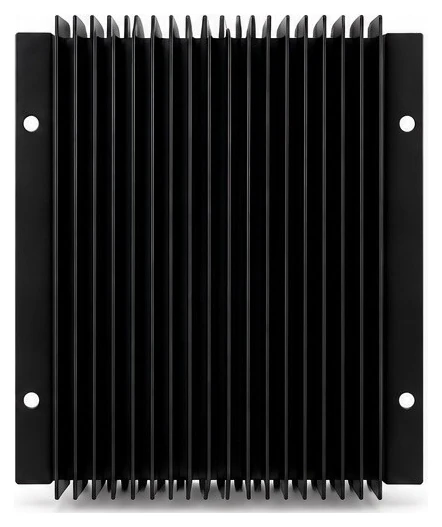
| Cooling | Passive — finned aluminium housing |
| Operating temperature | −20 °C to +55 °C · relative humidity max. 95% (non-condensing) |
| Protection rating | IP22 |
| Dimensions | 16 × 15,5 × 6,5 cm (G × U × D) |
| Warranty | 2 years |
| Nominal system | Continuous output power | Efficiency |
|---|---|---|
| 36 V | 540 W | 95% |
| 48 V | 720 W | %95,5 |
| 60 V | 900 W | %95,5 |
| 72 V | 1080 W | 98% |
24 V battery systems are supported as well; the manufacturer's data sheet does not state a separate continuous output power for 24 V.
What do BOOST MPPT, MPPT and LiFePO₄ mean? Solar Glossary →
Solar panel conversion for golf carts, hotel and estate service vehicles, and electric load or platform vehicles. Power from the panel reaches your battery pack through the MS Teknik BOOST MPPT 24-72 V — the vehicle charges even while parked, so it spends less time plugged in.
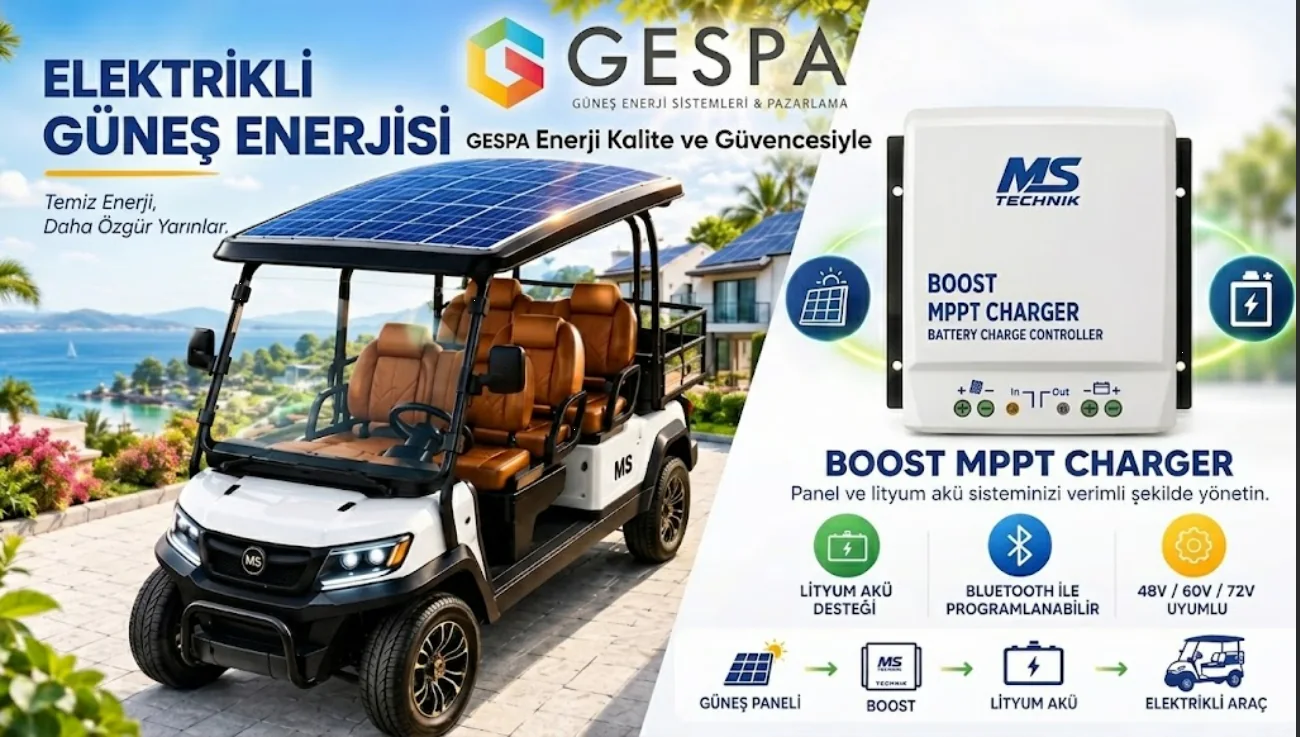
Electric vehicles are quiet and clean — but when the range runs out you still need a socket. A roof-mounted solar panel paired with the BOOST MPPT Charger reduces that dependency: every hour the vehicle stands outside it generates power, feeding the battery pack all day.
The chain is simple: the sun generates, the controller manages, the battery stores, the vehicle uses.
Mounted on the vehicle roof or upper platform, the panel produces direct current throughout the day.
It steps the panel voltage up to the battery pack level and, with its MPPT algorithm, draws the maximum power available in the current light.
Charge current is delivered to the pack under control. Settings are programmed to the pack's own ratings.
The vehicle keeps running off the same battery pack, and its need for grid charging drops.
From panel selection to cable cross-section, from the controller's position to the battery connection, the whole installation is done by our team. A system diagram is drawn up before anything on the vehicle's existing wiring is touched.
Electric vehicles that stand outside during the day benefit most from this conversion; the battery can be AGM, gel, lead-acid or lithium.
Vehicles that stay outdoors all day at hotels, resorts and golf courses — ideal conditions for a panel.
On the electric vehicles used by baggage, cleaning and maintenance teams it cuts the wait for charging between shifts.
A practical answer for electric vehicles working away from the grid in greenhouses, nurseries and large gardens.
The contribution depends on panel power and daily sunshine. A panel that fits on a vehicle roof supports the pack through the day rather than filling it from empty on its own: it reduces charging drawn from the grid and keeps the battery topped up while parked. We calculate the realistic contribution for your battery capacity together during the survey.
Yes. The unit works with AGM (VRLA), gel (VRLA), flooded lead-acid and lithium batteries; a user profile lets charge parameters match the battery maker's recommended values. We configure the correct profile during installation, so we confirm the battery type at the site assessment.
The unit supports 24, 36, 48, 60 and 72 V battery systems, with a panel input range of 15–60 V DC. Systems outside that range need a different solution — share your vehicle's rating plate and we will pick the right hardware together.
Charge parameters can be programmed from a phone and system status monitored. We set everything to your battery pack during installation; afterwards you can follow generation and charge status yourself if you wish.
The panel generates whenever it receives light, so the system works both parked and moving. Output is highest during the hours the vehicle stands unshaded in the open.
Manufacturers' warranty terms differ from brand to brand. We review your vehicle's warranty status with you before installation and never proceed without clearing it with you first.
We'll make a free assessment based on your vehicle's battery voltage and roof area.