
Supervision gap
In almost every case the child entered the water in the minutes a parent stepped away or lost sight of them in the crowd. In most incidents nearby guests did not notice what was happening.
A second pair of eyes that never tires — for your lifeguard.
Smart cameras watch your pool 24/7. When a risky situation is detected in the water, an alert with the exact location reaches your lifeguard's smartwatch within seconds. The system never replaces the lifeguard — it helps them every second.
ISO 20380-aligned technology · Footage never leaves your facility (KVKK)
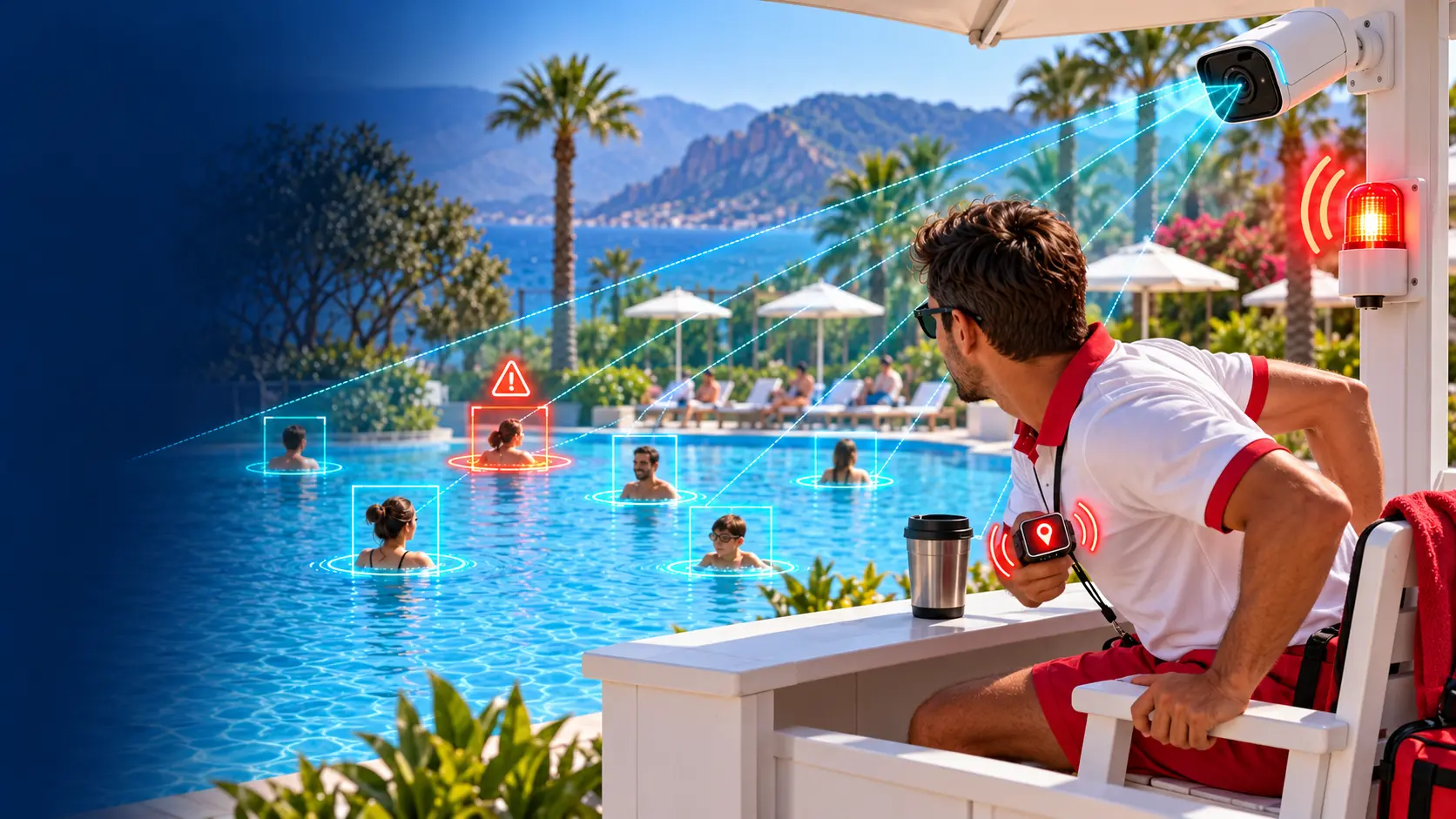
Real detection footage from a crowded pool: the AI marks every swimmer with an individual box and continuously scores their behaviour. When the risk threshold is crossed, an instant location alert goes to the lifeguard's smartwatch.
Cameras positioned around your pool continuously watch the entire pool surface. Retrofit installation is possible without draining the pool.
The system tracks each swimmer individually and analyses risk signals such as immobility, vertical sinking posture and panic movements in real time. All video processing happens on an on-site local server.
On detection, lifeguards get a vibrating alert on their smartwatch, a sound-and-light alarm at poolside, and the incident location on the control panel. The lifeguard knows where to jump — not where to look.
This system is not an alternative to the lifeguard. Your mandatory lifeguard count stays the same — the system covers the moments the human eye cannot see.
| Lifeguard | AI Support Layer | |
|---|---|---|
| Jumps in, intervenes, saves lives | ✔ Yes — rescue is always done by a human | ✖ No — it only raises the alarm |
| Gives first aid, takes care of guests | ✔ Yes | ✖ No |
| Watches without tiring or taking breaks | The human eye has physiological limits | ✔ 24/7 non-stop |
| Affected by glare and reflections on the water | Can be affected | ✔ Reduced through image processing |
| Watches the entire pool at once | Sees from a single vantage point | ✔ Scans the whole surface simultaneously |
| Keeps every alert as a record and report | No | ✔ Yes — auditable records |
The system does not replace the lifeguard; it tells them where to look. The legal obligation to employ lifeguards remains fully in force.
A real drowning usually happens within 20-60 seconds, without splashing or shouting. In a crowded hotel pool, that moment is short and silent enough to escape even the most attentive lifeguard.
According to an academic review based on press screening, 96 people lost their lives in swimming pools in Türkiye between 2011 and 2016. Cases cluster in June and July, and most of the victims are children.
In almost every case the child entered the water in the minutes a parent stepped away or lost sight of them in the crowd. In most incidents nearby guests did not notice what was happening.
Regulations set a mandatory number of lifeguards based on pool area and slide entry/exit points. Understaffing, gaps at shift changes and lunch breaks, and unmonitored blind spots are the recurring allegations.
The four-year-old who died in 2026 was in the adult pool. The lack of physical separation, barriers and access control between children's and adult pools is a recurring risk factor.
In legal proceedings liability does not stop at the lifeguard: general managers, security managers and occupational safety specialists are also arrested or found at fault. Charges of causing death by negligence have become standard.
The AI layer targets the supervision gap and blind spots: the pool surface is scanned continuously during shift changes, lunch breaks and peak hours, and a located alert reaches the lifeguard's watch the moment a risk appears. It does not replace the lifeguard, nor does it reduce the mandatory headcount — it closes the physiological limit of the human eye and turns every alert into an auditable record.
Data compiled from publicly available press sources (national and local outlets carrying Anadolu Agency, DHA and İHA wires) and from a DergiPark study of swimming-pool drowning cases in 2011–2016. The presumption of innocence applies to ongoing investigations; no facility or personal names are given.
A single fatal incident in the pool is not just a one-day crisis for a hotel:
No technology can guarantee detecting every incident. But an additional surveillance layer that watches continuously and records every alert helps manage both the risk itself and the answer to "were reasonable precautions taken?". The monthly service fee is small next to the items above.
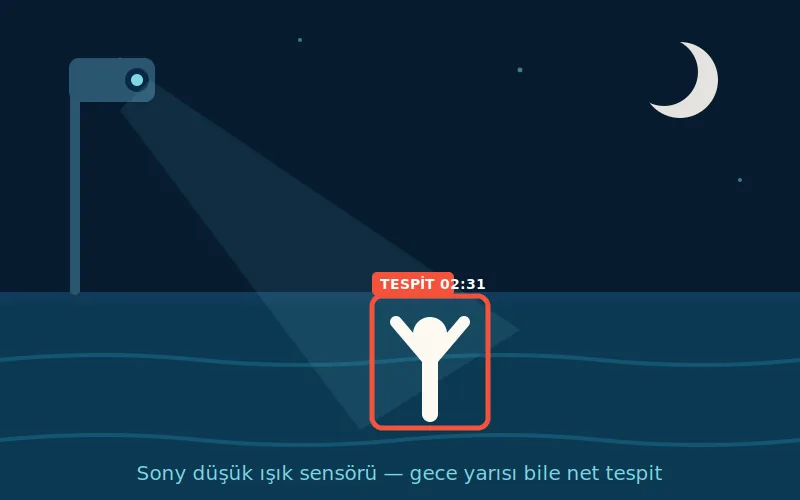
A light-sensitive sensor delivers clear detection even at midnight; for pools open at night, lighting is assessed during the survey.
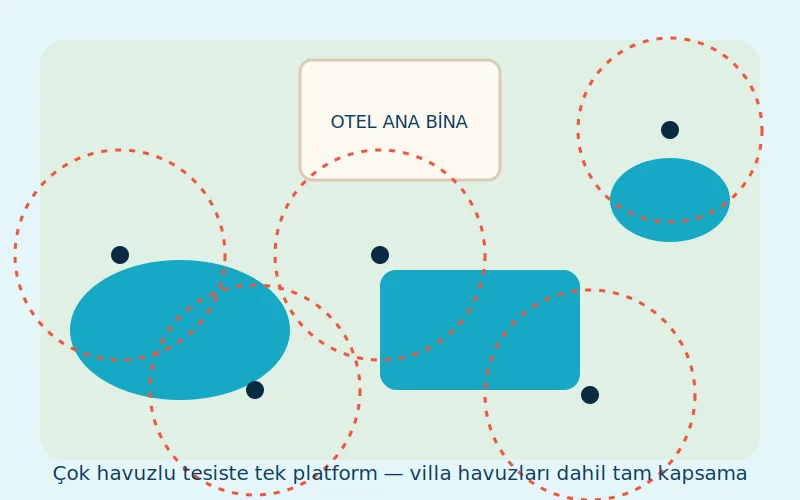
From the main pool to villa pools, every point is monitored on one central platform; the camera layout is engineered per facility.
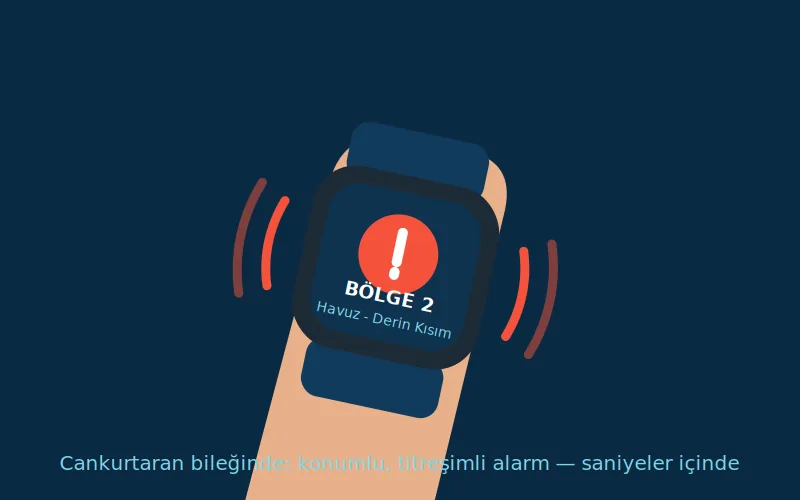
When risk is detected, a vibrating alert with zone information lands on the lifeguard's wrist — they know where to jump, not just where to look.
There are separate monitoring modes for free swimming, swim lessons and peak hours; the system switches between them automatically during the day. Normal movements during a lesson are thus far less likely to trigger a false alarm.
How many people entered the pool, which alert fired at what time: everything lands in your management panel as a daily report. You can show your safety performance in numbers.
Guest safety is reputation — a standard guests see and talk about. Pool safety is a visible criterion in family holiday decisions; a certified, verifiable safety layer is a difference you can concretely present in guest communication and agency negotiations. We don't guarantee ratings — your guests give those; we strengthen the safety side of the experience they rate.
The system adds a documentable safety layer to your insurance and risk-management processes; every alert is logged.
Slide run-outs, wave pools and heavy child traffic — where the human eye struggles most, the system never tires.
Easy oversight and reporting for facilities with high visitor turnover; a measurable safety standard for communal use.
Gespa Enerji is an Antalya-based energy technology company. Our team, already serving hotels with solar energy and heating solutions, now brings the same engineering discipline to pool safety. Distributorship and authorised-service processes with international drowning-detection manufacturers are underway; every installation is carried out by certified crews and delivered with on-site acceptance tests.
The system we use is installed across three continents, from hotels to Olympic centres, at facilities of every scale.
Installed facilities include city and resort hotels of international five-star chains, Olympic swimming centres, aquaparks, schools and residential pools.
The installations cited are our technology partner's global references; installations in Türkiye are carried out end-to-end by Gespa Enerji. Brand names are published only with the written consent of the facilities concerned.
The system hardware has been tested in accredited laboratories. The document numbers below let you verify the source of each report.
The mandatory certificate showing the device complies with European safety rules.
Belge No: CTW2510004501 · Test Lab: CNAS akredite (L1225), ILAC-MRA üyesiShows the device's electromagnetic field stays within limits safe for human health.
Report No: CHTW25100048 · Result: PassThe test showing the device is electrically safe.
Report No: CHTE25100104The international standard for camera-based drowning detection in pools. This standard, too, defines the system as support for the lifeguard — not a replacement.
Compliant technologyFootage is processed on a local server inside the facility; it is not sent to the cloud or abroad.
Privacy notice and retention policy are delivered with the installationCopies of the documents are shared with corporate clients on request.
The first question asked after an incident is: "Did the operator take reasonable precautions — and can it prove that?" The system automatically produces records every day that can support the answer:
This record-keeping helps document your duty of care in judicial or administrative proceedings and adds a measurable safety indicator to your internal audits and chain standards.
It is a concrete set of precautions and records you can add to your risk-management file at policy renewal talks. Premiums and coverage remain at your insurer's discretion; we provide the documents you bring to that conversation.
There are two options:
Which suits your facility? After the free survey we present both options as a written quote.
No — and it shouldn't. The international ISO 20380 standard defines these systems as a secondary supervision layer supporting the lifeguard. It extends your lifeguard's field of view and reaction speed.
No. Lifeguard numbers and qualifications are set by regulation; the system does not reduce or remove that obligation. ISO 20380 likewise defines this technology as a secondary surveillance layer supporting the lifeguard. Its contribution is not staff savings: it extends your existing team's field of view to the whole pool, delivers location information within seconds at the moment of risk, and turns every alert into a record you can show in audits.
Yes. In most projects installation is possible without draining the pool or closing the business; cabling and mounting can be scheduled for hours when the pool is closed. Total duration depends on the number of pools and existing infrastructure; the exact schedule is committed in the written quote after the free survey. After installation the system is calibrated for your facility and your lifeguard team receives on-site training. Facilities that prefer not to start mid-season can reserve next season's installation slot now.
Standard security cameras are designed for general surveillance; reflections, glare and viewing-angle issues on the water surface usually make them insufficient for drowning detection. The system runs on its own cameras designed for this task. That said, your existing cabling, network and recording infrastructure is assessed during the free survey; suitable parts can be reused, which can reduce installation time and cost.
The camera count is engineered from the pool's surface area, shape, depth zones and blind spots; the goal is continuous coverage of the entire surface. A single regular-shaped pool may need only a few cameras, while pools with slides or divided sections need a larger coverage plan. The exact count and layout are presented in the written quote with a coverage sketch prepared at the free survey.
No system can promise zero false alarms; quality systems are designed to keep them to a few per day and are calibrated per facility. Every alert is stored as a record and report.
Footage is processed on an in-facility server and is not transferred to the cloud or abroad. The recording policy is configured to keep only incident moments, in line with data-protection law, and privacy notices are displayed at facility entrances.
With installation you receive pool-specific privacy notice and retention policy templates; your facility's main step is displaying these visibly at entrances and adding them to your existing KVKK documentation. Cameras are engineered to see only the pool and its surroundings; changing cabins, showers and similar private areas are excluded from coverage. Footage is processed on the on-site local server and is not transferred to the cloud or abroad. For the final legal assessment we recommend having your own KVKK counsel approve the texts.
The price has three main components: camera count per the coverage plan, the on-site AI server with alarm units (smartwatches, audible-visual alerts) and installation-calibration labour. Since pool count and size differ per facility, instead of a single list price we present a written quote with a coverage sketch after the free survey. You can pay as a one-time turnkey investment or via the Monthly Safety Service model bundling hardware, software, maintenance and support: from 299 USDper month, options up to 36 months.
Yes. After the installation fee we offer fixed monthly service plans covering hardware, software, maintenance and support in one package. From 299 USDper month, with payment options of up to 36 months.
Our CE/RED test reports carry accredited laboratory numbers; the document numbers are listed openly in the Certification section of this page. Report copies are e-mailed on corporate request.
Fill in the form; our team will call you within 1 business day.
Important notice: The AI Lifeguard Support System does not replace lifeguard supervision; it is an additional safety layer that supports it. No technological system can guarantee detection of every drowning incident. The system does not remove lifeguard staffing obligations under applicable regulations. Product features may vary depending on the installed system configuration.